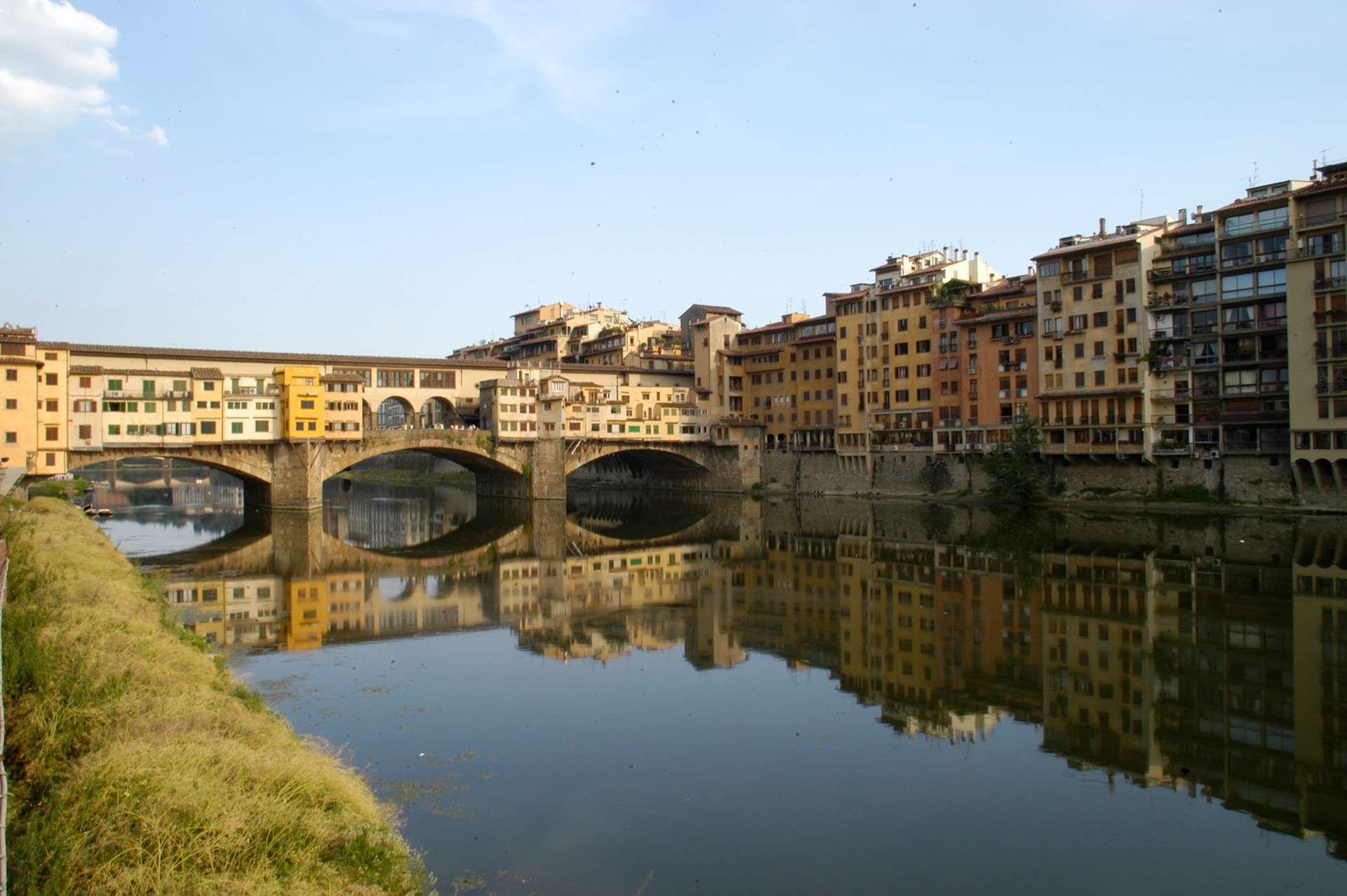
Florence travel guide
Best places to eat, drink, see and do in the Renaissance City
For two centuries, the arts thrived in Florence like never before. Under the patronage of the powerful Medici family, in the 1400s and 1500s, this was the centre of the Western world.
The legacy of that period is unrivalled anywhere on the planet, and is preserved on the walls of the Uffizi, in the corridors of the Palazzo Vecchio, on the domed roof of the Duomo, and in churches like Santa Croce and Santa Maria Novella.
Away from the art, the living here is good, too. The Chianti hills are on the doorstep, so a steady stream of fine wine flows through the city gates.
In a short guide like this, it’s impossible to do more than merely scratch the surface of the city. We suggest a good guidebook like “Frommer’s Easy Guide to Rome, Florence & Venice”, or a themed walk with Context Travel if you want to linger longer or dig a bit deeper (and if you can, you really should).
A Brief History of Florence
Florence practically invented the Renaissance. Not only in art and architecture, either. Dante and Boccaccio were the first to write for the masses in what’s now the Italian language. Macchiavelli’s philosophy of ruthless “Realpolitik” was hugely influential in the conduct of statesmanship for centuries (and perhaps still is).
But it is Florence’s painters, sculptors and architects that still draw millions every year. The Galleria degli Uffizi houses the world’s best collection of Renaissance painting: Giotto, Raphael, Michelangelo, Botticelli, Leonardo da Vinci, and many, many others are all here. The place is very popular, and rightly so.
The city’s most famous artwork isn’t in the Uffizi, however. Michelangelo’s David — aka “Il Gigante” —originally stood outside the Palazzo Vecchio. In 1872 the statue was moved, on a specially designed trolley-tram, to a room at the Galleria dell’Accademia that was designed purely to show him off.
What to See in Florence: Top Historical Landmarks
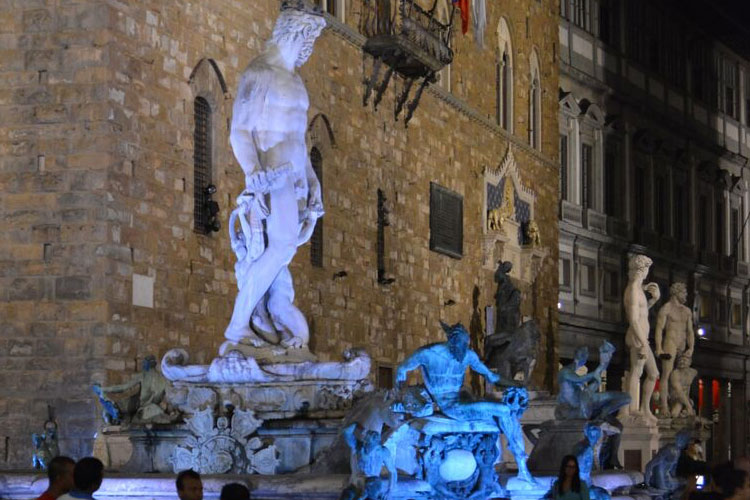
A replica now stands in David’s place in Piazza della Signoria, where there is no admission fee to enjoy the open-air art spectacle. Standing in the morning shadow of the Palazzo Vecchio — where key scenes from Dan Brown's novel “Inferno” played out — you can see how David measures up to Baccio Bandinelli's Hercules, Bartolomeo Ammanati's Neptune, and Giambologna's Equestrian Statue of Cosimo I.
Under the Loggia dei Lanzi, copies of Roman statues are joined by Mannerist originals, including Cellini's bronze, Perseus Holding the Head of Medusa (1545).
Cattedrale di Santa Maria del Fiore
The monuments of Piazza del Duomo are icons of Italy. The Cattedrale di Santa Maria del Fiore was begun by Gothic architect Arnolfo di Cambio, and was always intended to have a domed roof. Trouble was, neither the Florentines, nor anyone else, had any idea how to make one across such a wide span. Then Filippo Brunelleschi came along in the 1440s with a solution. His revolutionary double-skinned dome (the cupola) is the crowning achievement of Florentine architecture. You can climb to the lantern for some of the best views over the city. (Beware: it's a trip that's definitely not for claustrophobes or anyone with a fear of heights.)
Battistero, Gates of Paradise and Museo dell’Opera del Duomo
The city's octagonal Battistero (Baptistery) has more ancient roots. No one is sure exactly when it was built, but definitely before the 8th century. Lorenzo Ghiberti's Gates of Paradise — its bronze east doors, facing the cathedral — show scenes from the Old Testament, cast in low-relief. They took a couple of decades to make, and were unveiled in 1452. The restored originals are exhibited at the Museo dell’Opera del Duomo, which opened in vastly expanded premises in 2016.
Santa Maria Novella
Almost equally significant in art history is Santa Maria Novella. Its polychrome façade fuses Romanesque styling — begun when the church was built from 1246 — with geometrical Renaissance classicism in the upper orders, added harmoniously by L. B. Alberti in the 1460s.
Inside, Masaccio’s Trinity was the first painting to realistically depict linear perspective on a flat surface. When it was unveiled in 1428, amazed Florentines were convinced Masaccio had punched a hole in the wall, such was the realism.
The Tombs of Florence’s Great Artists and Thinkers
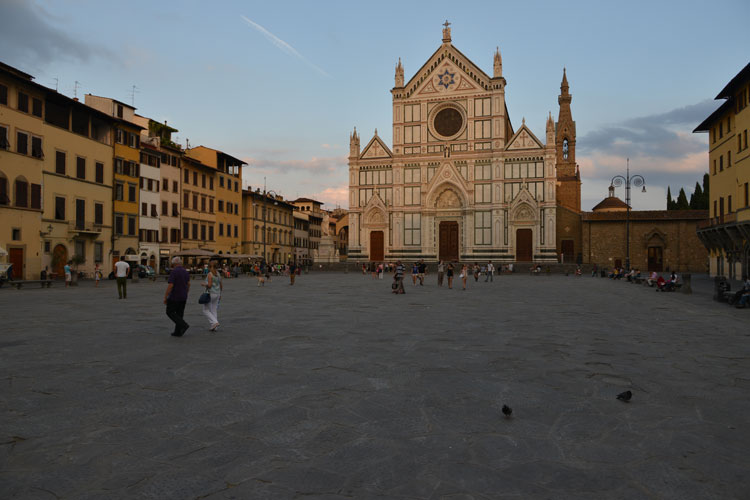
Across town, the nave at Santa Croce is lined with monumental tombs of famous Florentines, including Michelangelo (he died in Rome but his body was smuggled back home); Macchiavelli; and Dante (not a tomb, as he died in exile, in Ravenna). Two transept chapels were frescoed by Giotto di Bondone, an early 14th-century painter sometimes called the “Father of the Renaissance”. You might even recognize the Peruzzi Chapel from “A Room with a View”.
Capelle Medicee
Attached to the Basilica of San Lorenzo, the Medici Chapels or Cappelle Medicee are an essential visit for history buffs. If you’re short on time, start with a look around the opulent octagonal Chapel of the Princes. A small passageway leads to Michelangelo’s secret room, which opened to the public in 2023 fifty years after discovery. In 1530, Michelangelo spent two months hiding in this tiny chamber, making dozens of chalk and charcoal drawings.
Fra Angelico at the Museo di San Marco
Florence counts the highest number of Fra Angelico masterpieces. Working sensitively with religious subjects, Angelico was among the most important Italian painters of the first half of the 15ᵗʰ century. You can visit the San Marco Museum in the Oltarno neighbourhood for some of his best works. The museum’s standout frescoes depict profound scenes from the Bible, imbued with delicacy and brilliance of colour.
Giotto's Bell Tower
Looming over the Duomo, the Bell Tower or Campanile is hard to miss. Designed by Giotto in 1334, it is a splendid example of 14th-century Gothic architecture. Mornings are the best time to visit, when the temperatures are cooler. Descend the tower’s steep and narrow staircase with care – all 414 steps lead to a spectacular viewing point of Florence’s terracotta rooftops.
Where to Eat in Florence
Florentine flavours are bold and straightforward, and the city’s trademark cooking style is typically no-nonsense. However, alongside the spezzatino (veal stew), roast meats, and trippa alla fiorentina (tripe cooked with tomatoes), a new generation of chefs offer a lighter interpretation of Florentine cooking.
Florence also fights it out with Sicily for the claim to have invented gelato, an ice-cream-like dessert made with fresh milk. What indisputable is that the city’s gelaterie are some of the best in Italy.
Saporium
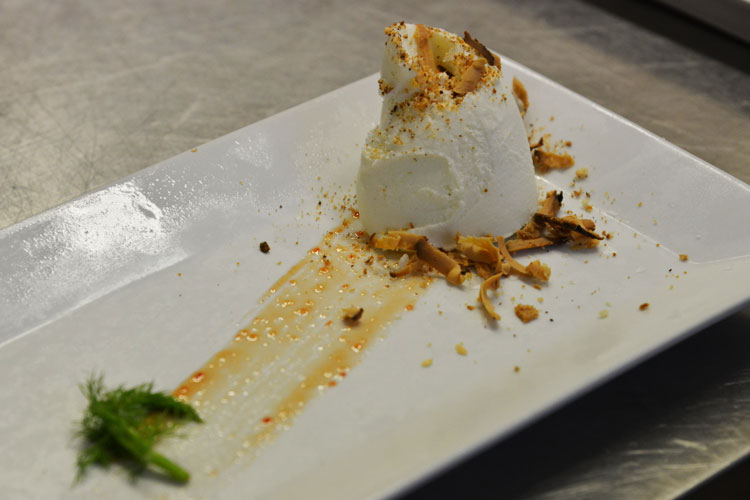
Ideal for a special occasion, Saporium delivers Chef Ariel Hagen’s Michelin-starred fare, showcasing seasonal produce from the property’s bio-dynamic farm and fermentation lab. The wine list is extensive, carefully curated to complement the kitchen’s evolving tasting menus. Highlights include Hagen’s signature pigeon-stuffed agnolotti, often paired with a refined Burgundy Pinot Noir.
Area: Chiusdino
Website: saporium.com
L’Angolo del Mare
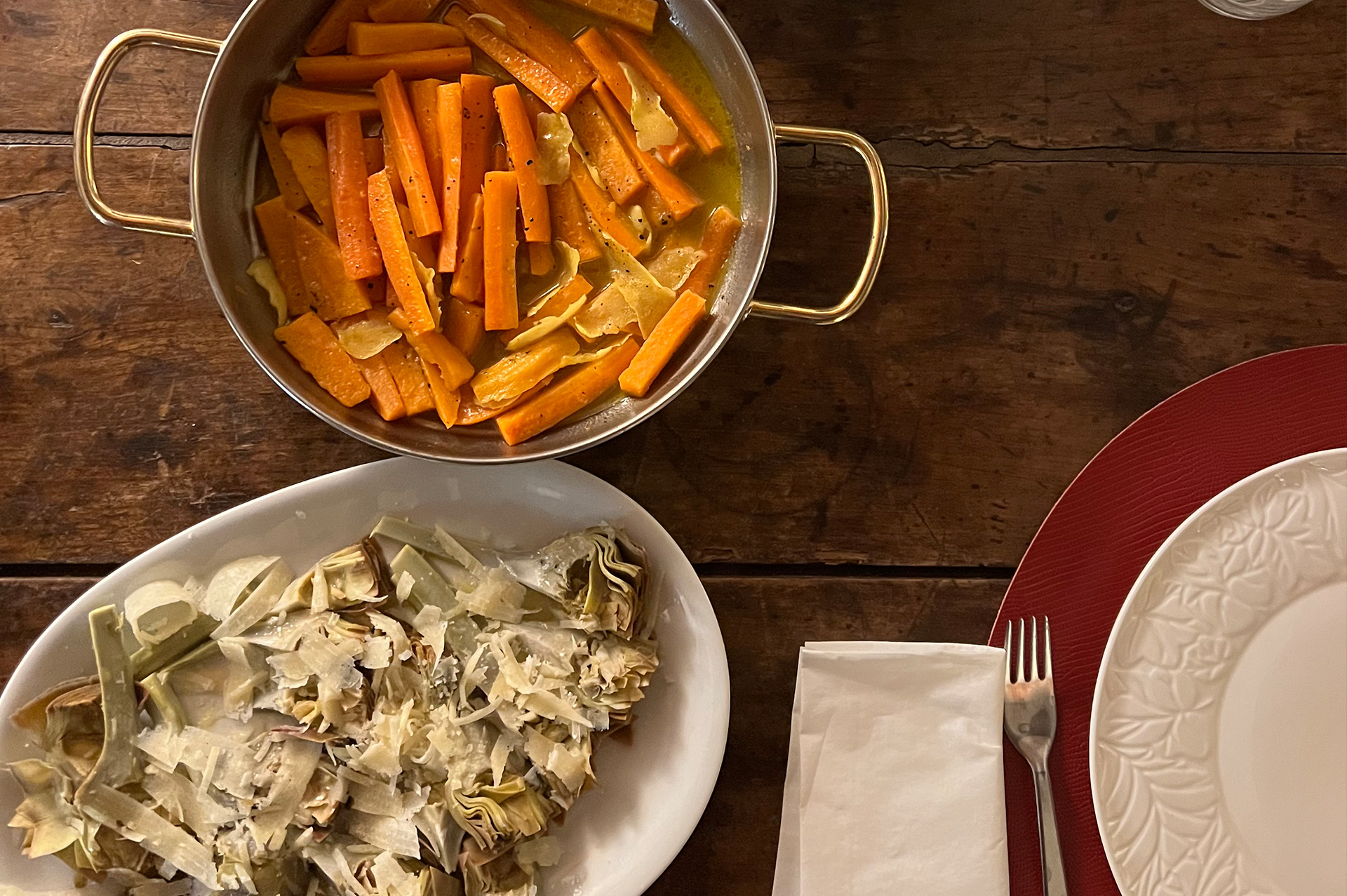
Seafood lovers should head straight to this smart yet unpretentious restaurant just south of the football stadium. Loved by locals for its relaxed atmosphere and dedication to fresh local catch, L’Angolo del Mare focuses on simple recipes that let the quality of the seafood shine. Standouts include griddled octopus and aubergine, the linguine with clams and an exquisite tagliolini with astice (lobster).
Reservations at L’Angolo del Mare are essential, so it is recommended to book in advance. Guests staying in one of our luxury villas near Florence can take advantage of our complimentary concierge service to handle all arrangements on their behalf.
Area: Coverciano
Website: langolodelmare.com
Coquinarius
Coquinarius offers a refuge from the tourist-packed Duomo. Retreat inside this cosy wine bar and restaurant to enjoy platters of mixed cheeses and cured meats. The excellent homemade primi also deserves a mention, paired with a generous selection of Italian wines.
Area: Centro Storico; Fiesole
Website: coquinarius.it
Read our guide to the best restaurants in Florence for more recommendations.
Out of Town
Explore Certosa del Galluzzo
On a knoll at the farthest southern reaches of suburban Florence stands the Certosa del Galluzzo. Founded in 1342, the vast monastery has been expanded and altered over the centuries, and is best known for frescoes by Mannerist painter Pontormo (1522).
Visit Prato
Prato, 15 miles north-west of Florence, is Tuscany’s second city and a major producer of leather and textiles. It has long links with Wenzhou, in China: Italy’s third-largest Chinese community, after Milan and Rome, calls it home.
Its main art treasure is inside the Duomo - scenes from the Life of St. John the Baptist, completed in 1465 by Filippo Lippi. The striped façade has a curious circular pulpit (1438) bolted onto the front, a joint venture between architect Michelozzo and sculptor Donatello. You can view the original next door, in the Bishop’s palace that now forms the Prato’s Museo dell’Opera del Duomo.
Prato is also the home of the biscotti di Prato — “Pratese biscuits”, made from almond flour, and more commonly called cantuccini. Wrapped in their royal blue packaging, they make a great gift.
Discover Florence’s parks and gardens
You will find one of Italy’s grandest gardens within Florence’s city limits. Behind the Palazzo Pitti, the Giardino di Boboli is laid out in the formal Renaissance style, with ordered walkways and carefully planned views of the palace and skyline, with hidden corners like the Isolotto (including dancing fountains) and the Hemicycle, a faux-Roman garden.
The Boboli was also the venue for the first ever opera: Jacopo Pieri set “Euridice” to music, for the marriage of Maria de' Medici and Henri IV of France, in 1600
Where to go shopping in Florence
After Milan, Florence is Italy’s best shopping city. Like its northern neighbour and rival, fashion is big business. The main haute couture drag is Via de’ Tornabuoni. Along here, and in side-streets like Via della Vigna Nuova, you’ll find major names in Florentine fashion (Gucci, Pucci, Ferragamo) as well as Milanese and world designer labels like Prada and Armani.
Visit independent bookshops and vintage stores
Just north of the Duomo, Via dei Servi retains the vibe of old Florence and the era before mass tourism. There you can window-browse independent booksellers, a philately store, traditional stationer’s, and more. Borgo degli Albizi, in the eastern part of the centre, has a younger feel to its fashion, with vintage shops, too.
Design your own fragrance
There has been a “pharmacy” on the site of the Officina Profumo-Farmaceutica di Santa Maria Novella since it was founded by Dominican friars in the 1600s. The present incarnation sells top-end fragrances and skincare for everyone (even the family pet). And if you don’t love what’s in stock, you can design your own fragrances.
Watch the artisans in action
Florence also has a rep for leather. Everything at the Scuola del Cuoio is made on the premises by students at the city’s most prestigious leather-making school. Turn up during school hours (weekdays only) and you can watch trainee artisans at work.
Browse Florence’s markets and take home a souvenir
The city also has several markets. The much-photographed Mercato di San Lorenzo is stuffed with souvenirs; the Mercato Centrale is Florence’s covered food market, selling everything from salami and cheeses to Chianti wine. The upper floor is Italian street food heaven.
Where to stay in Florence
Base yourself at one of our luxury villas near Florence, which range from restored farmhouses to Medici villas.
Offering an impeccable culinary experience, the Estate of Petroio is one of the finest properties to rent in Tuscany, located a short drive from Florence’s restaurants, cafes and boutiques. Or stay in a grand noble estate at Villa Tinaccio near Florence, which has been in the same family since 1428. Our Villa Specialists will match you to the perfect villa for you and your guests.
Three Day Trips from Florence
- Impruneta: the home of terracotta and spicy peposo stew offers a total change of pace — and a real slice of small-town Tuscany.
- Siena: a labyrinthine mini-city of red-brick palaces and medieval art, and also host of the world-famous Palio horse races each July and August.
- Fiesole: this ancient Etruscan settlement high on a hill to the north has the best views over Florence, as well as archaeological remains that date to well before its large neighbour even existed.